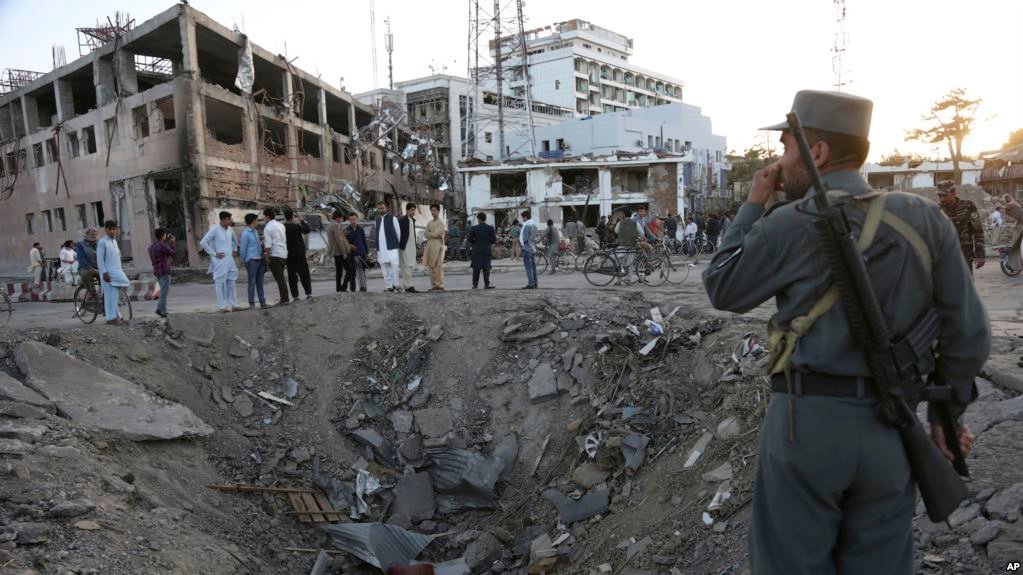
Security forces stand near to the ditch created by massive explosion in front of the German Embassy in Kabul, Afghanistan, Wednesday, May 31, 2017. A massive explosion rocked a highly secure diplomatic area of Kabul on Wednesday morning, causing massive casualties and sending a huge plume of smoke over the Afghan capital. (AP Photos/Rahmat Gul)
No militant group has so far claimed responsibility for Wednesday’s (May 31) powerful blast that ripped through Kabul’s diplomatic quarter, killing at least 90 people and wounding hundreds of others.
The attack, condemned by the international community, underscores how the Afghan capital has become one of the deadliest places in the country for civilians.
As the silence stretches and public anger grows, the main suspects are yet no clear but below choices are possible:
The Afghan Taliban
The Taliban have denied they were involved – but analysts say that should not be taken at face value.
Currently in the midst of their so-called “spring offensive”, the Taleban – who seek to drive foreign forces from Afghanistan and to rule the country through their extremist interpretation of Islam – are by far its biggest and most powerful insurgent group.
They were ousted from power in a US-led invasion in 2001, but have seen a resurgence since the withdrawal of front line NATO combat troops in 2014, briefly capturing key cities in addition to vast swathes of countryside.
In recent years the group – sensitive about its public reputation – has shied away from claiming attacks on civilian targets, though analysts believe this could be a tactic of convenience.
DAESH
The DAESH has little hesitation in raising its hand to take credit for bloody attacks, including those on ‘soft targets’, as it seeks to spread its so-called ‘caliphate’ from its Middle East base.
They have carried out several attacks in Kabul, nearly as deadly as Wednesday’s: Last July they claimed a bombing that killed more than 80 people in the city.
In March, they claimed a deadly raid on Afghanistan’s largest military hospital that officially killed 60 people, slaughtering patients in their beds – though survivors and analysts suggested that attack also bore the hallmarks of the Taleban.
The group – made up mainly of former disaffected Taleban and Al Qaeda fighters.
While DAESH supporters celebrated Wednesday’s assault in Kabul on social media, the group has not claimed responsibility for the attack.
Haqqani terrorist group
Afghanistan’s intelligence agency has blamed the Taleban-allied Haqqani Network for the attack, which has long been thought to have ties to neighboring Pakistan’s shadowy military establishment.
Led by Sirajuddin Haqqani, who is also the Taleban’s deputy leader, they have carried out numerous operations deep in the heart of Kabul, including the 2008 Indian embassy bombing that killed almost 60 people.
Al-Qaeda and other groups
The group behind the 9/11 attacks were written off as a spent force by many in Washington following the killing of their chief Osama bin Laden deep inside Pakistani territory in 2011.
Bill Roggio of the Long War Journal, while testifying before US Congress in April, said this was a mistake and its symbiotic relationship with the Taleban, which has strengthened, meant that “Al-Qaeda has more areas to plant its flag”.
Several Pakistani groups round out the militant landscape in Afghanistan, including the Pakistani Taleban, the Lashkar-e-Taiba and Harkat-ul-Mujahideen, none of whom are believed to have the capacity to have carried out Wednesday’s attack in Kabul.
Source: Straits Times